Horizon Europe lump sum funding: how payments work
Most Horizon Europe topics now pay a lump sum instead of reimbursing costs. The money follows completed work packages, so the way you cut your work plan decides when you get paid. Here is the full mechanism, with the live lump sum topics.
Horizon Europe lump sum funding pays your project a fixed amount per work package, released when the work is done, with no cost reporting and no financial audits. Right now 206 of the 324 live Horizon Europe topics (64%) pay this way, so the odds are high that the next topic you apply to is one of them.
The short answer: you estimate your costs in a detailed budget table, the Commission fixes the lump sum from that table and splits it into shares per beneficiary and per work package, and each share is paid once its work package is completed. The rules come from the Commission guide Lump sum funding: what do I need to know? (version 3.0, 24 June 2024, source) and the Commission Decision authorising the use of lump sum contributions under the Horizon Europe Programme (source).
How many Horizon Europe topics pay a lump sum today?
| Action type | Live topics | Pay a lump sum | Share | Typical lump sum grant |
|---|---|---|---|---|
| Research and Innovation Action (RIA) | 145 | 100 | 69% | €4.5 million |
| Innovation Action (IA) | 108 | 64 | 59% | €6 million |
| Coordination and Support Action (CSA) | 47 | 42 | 89% | €3 million |
The gap between the topic share and the budget share tells the real story. Lump sums dominate the number of topics, while the biggest budget lines still run on actual costs: the median actual-cost topic pays up to €10 million per grant, against €5 million for a lump sum topic. 17 of the live lump sum topics use two-stage submission, so the budget table only matters once you reach the second stage. All figures come from the Funding & Tenders Portal data behind the full list of Horizon Europe calls.
How is the lump sum amount fixed?
The Decision sets one principle above all others: the lump sum must be “an approximation of the beneficiaries’ underlying actual costs”. You build it from the same cost categories as a classic grant: personnel, subcontracting, travel, equipment, other goods and services, and, where the topic allows it, financial support to third parties. Two things are already baked into the amount:
- The 25% flat rate for indirect costs, which the Decision includes in the calculation where it applies.
- The funding rate of your action type. The General Annexes of the 2026-2027 work programme state that for lump sum grants the funding rate is applied while fixing the amount and is “not shown in the grant agreement” (source). RIA and CSA topics fund 100%, IA topics 70%, with 100% for non-profit legal entities.
The guide describes two types. In Type 1 the lump sum is fixed in the call. In Type 2 you define the lump sum yourself in your proposal through the detailed budget table. The topic text tells you which type applies.
Once the grant agreement is signed, the amount stays put: the guide states that the lump sum “will not be questioned” if prices for goods or services change later. A consortium that buys equipment cheaper than planned keeps the difference, and one hit by price rises absorbs them.
Lump sum or actual costs: what changes for your project?
| Lump sum grant | Actual cost grant | |
|---|---|---|
| What triggers payment | Completed work packages | Eligible costs you report |
| Financial reporting | Generated from accepted work packages | Cost statement per beneficiary |
| Financial audits by the Commission | None; checks cover the technical work and other obligations | Yes, on the costs declared |
| Timesheets, pay slips, invoices for the grant | Not needed | Needed |
| Extra proposal annex | Detailed budget table (Excel), unless the topic fixes the lump sum | None |
| Page limit, full proposal | 45 pages for RIA and IA, 28 for CSA | 40 pages for RIA and IA, 25 for CSA |
| Moving money between partners | Free inside the consortium; the grant agreement changes only by amendment | Budget transfers under the grant agreement rules |
The page limits come from the 2026-2027 General Annexes, every other line from the lump sum guide. Evaluators score a lump sum proposal on the same three criteria as any other, and they check the cost estimates under Implementation.
How are lump sum payments made, step by step?
- Pre-financing. The guide confirms it follows the same function and rules as in other grants, and the coordinator distributes it under the consortium agreement.
- End of each reporting period. The coordinator declares every work package due in that period as Completed or Not Completed, backed by the technical periodic report.
- Review by the project officer. Before rejecting a work package you declared completed, the Commission invites you to respond to its observations.
- Interim payment. The Commission pays the lump sum shares from Annex 2 of the grant agreement for the work packages it accepted. The financial statement is generated automatically from those shares.
- Rejected or late work packages. Their share waits. You finish the work and declare it at the end of a later reporting period.
- Final payment. Only here can you declare a work package Partially Completed with a percentage, and the share is paid in line with the degree of completion the Commission accepts. The final payment also releases the amount retained for the Mutual Insurance Mechanism.
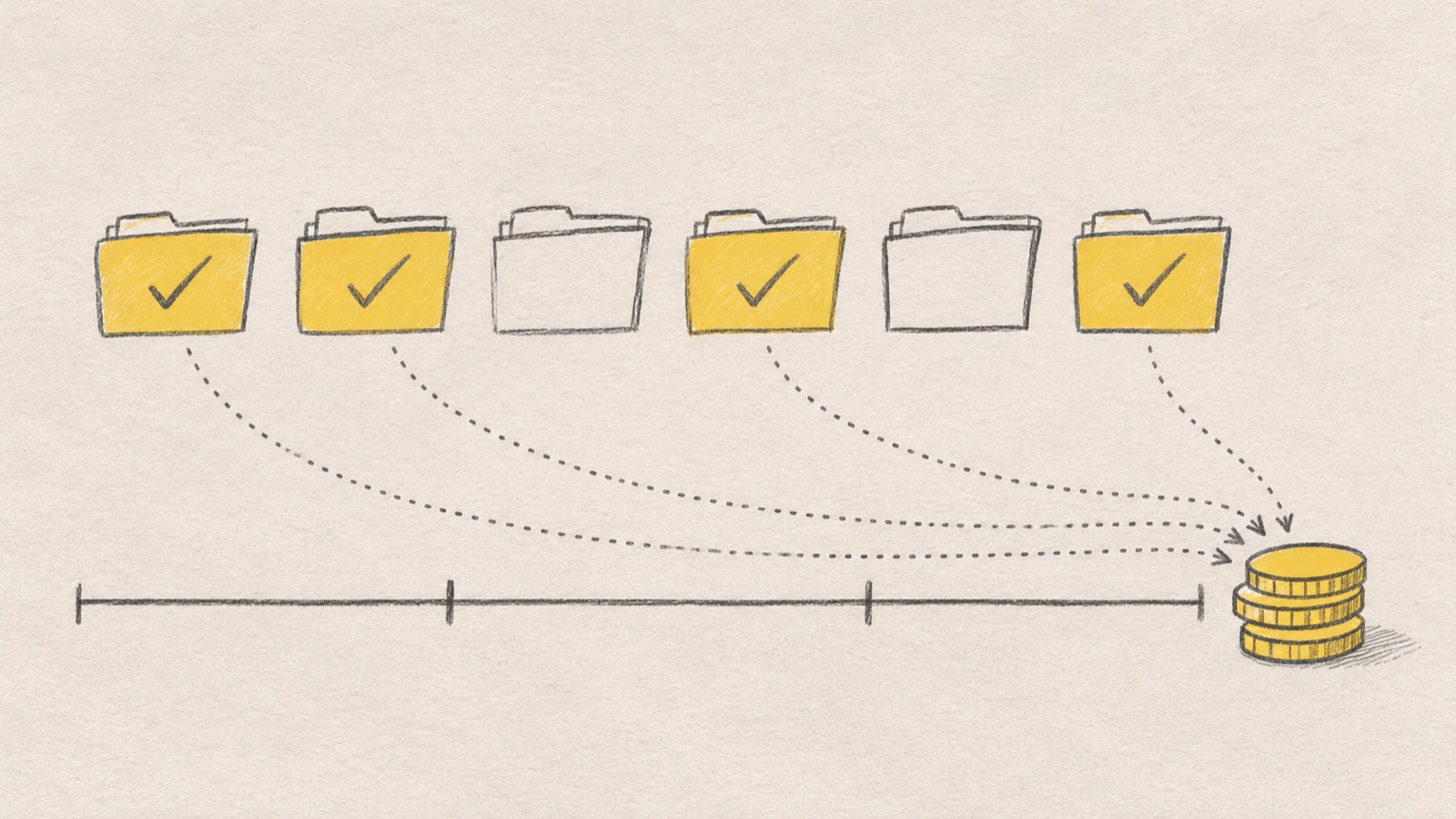
Here is how the arithmetic plays out. Take a grant of €1,000,000 split into WP1 at €300,000, WP2 at €500,000 and WP3 at €200,000. At the end of the first reporting period WP1 and WP2 are done and WP3 is running late. The Commission counts €800,000 as accepted and the €200,000 of WP3 waits for the next period. If WP3 ends the project at 60% completion and the Commission accepts that figure, the final payment counts €120,000 for it.
Completion is measured against the activities in the description of the action. The guide puts it plainly: “Payments do not depend on a successful outcome, but on the completion of activities.” The Commission can also accept a work package “when all essential tasks have been completed”, when equivalent tasks replaced the planned ones or when you justified the deviation.
How do you fill in the detailed budget table?
The budget table is an Excel file you download from the submission system and upload as an annex to Part B. The guide sets the rules:
- List every beneficiary and affiliated entity in the BE list sheet, with country and funding rate.
- List the work packages in the same order as Part B.
- Enter cost estimates per beneficiary and per work package: number of items and cost per item. One personnel item equals 1 person-month.
- Check personnel costs against the Horizon dashboard for lump sum evaluations, which shows the 20th to 80th percentile of monthly personnel costs by country and organisation type. Costs above it need a justification in the “Any comments” tab.
- Fill table 3.1h in Part B for any beneficiary whose purchase costs exceed 15% of its personnel costs.
- Save as .xlsm while you work, upload as .xlsx or .xls, since the system refuses the macro format.
The General Annexes add a hard edge: if the table contains ineligible costs, the grant can be reduced “even later on during implementation of the project or after its end”. Overestimated costs found by the experts lead to a lower lump sum in the grant agreement without a lower score, while a budget unfit for purpose costs you points.
How should you cut your work packages?
Your work plan is now your invoice schedule. The guide gives four rules: a single activity is not a work package, a single task is not a work package, a percentage of progress such as “50% of the tests” is not a work package, and a period of time such as “activities of year 1” is generally not one either.
Long work packages such as management or dissemination block money until they end. The fix from the guide: split them along reporting periods (WP1 Management RP1, WP2 Management RP2, and so on) so each slice is paid at its interim payment. You describe the shared tasks once in table 3.1b.
How many lump sum grants lose money?
The Commission published hard numbers in its Assessment of Lump Sum Funding in Horizon 2020 and Horizon Europe of 25 July 2024 (source):
- 96% of 520 closed lump sum grants were paid in full, and the average payment came to more than 99% of the maximum grant amount.
- 8 of those 520 grants saw the project officer accept less completion than the consortium declared. Their median cut was 11%.
- About 1% of work packages declared completed were rejected at an interim payment, with no effect on the final amount once they were accepted before the project ended.
- 90% of lump sum budgets were funded as requested after evaluation; the cuts in the other 10% had a median of 0.7%.
- 57% of applicants said the detailed budget table took less than 1 person-day.
The same report records the intention to reach a 50% share of lump sum funding in Horizon Europe by 2027, after lump sums spread in 2024 to the ERC Advanced Grants and the EIC main funding schemes.
Which lump sum topics close next?
| Topic | Type | Deadline | Per grant |
|---|---|---|---|
| HORIZON-CL5-2026-11-D3-06 Resource assessment for deep sedimentary and basement reservoirs | RIA | 1 December 2026 | €4.5 million |
| HORIZON-CL5-2026-11-D3-14 Improved system design for innovative PV applications (EUPI-PV Partnership) | IA | 1 December 2026 | €7.5 million |
| HORIZON-NEB-2026-01-BUSINESS-02 Understanding capital market dynamics for increased investment in New European Bauhaus projects in neighbourhoods | RIA | 1 December 2026 | €3.5 million |
| HORIZON-NEB-2026-01-REGEN-02 Advancing sustainable maintenance and repair measures for existing buildings | IA | 1 December 2026 | €5 million |
| HORIZON-NEB-2026-01-PARTICIPATION-03 Understanding inhabitant’s experiences of neighbourhoods to support their health and well-being | RIA | 1 December 2026 | €5 million |
| HORIZON-NEB-2026-01-PARTICIPATION-01 Addressing homelessness through housing-led approaches aligned with the New European Bauhaus | IA | 1 December 2026 | €6.3 million |
Each topic page shows the funding model next to the action type. The full list of live lump sum topics follows below this guide.
Which lump sum mistakes cost consortia money?
- One work package per year. A time slice is not a work package, and a vague one is hard to declare completed.
- A giant management work package. It pays nothing until the last month. Split it per reporting period.
- Copying costs from a past actual-cost grant without checking eligibility. Ineligible items in the budget table can reduce the grant after the project ends.
- Promising results instead of activities. Write each work package as tasks you control, since completion is judged against the description of the action.
- Treating the Excel file as an afterthought. Its totals per beneficiary are the amounts you enter in the Part A budget table, so update both together.
Put Horizon Europe deadlines on your own site
Grant offices that explain lump sums to their researchers also need the dates in front of them. The free EU deadlines widget lists the live Horizon Europe topics on any website and updates itself 3 times a day.
Source of all call data: EU Funding & Tenders Portal, © European Union, CC BY 4.0. Rules quoted from Commission documents, © European Union, CC BY 4.0. Counts by Yellow Grant.
Open calls right now
Resource assessment for deep sedimentary and basement reservoirs
Improved system design for innovative PV applications (EUPI-PV Partnership)
Understanding capital market dynamics for increased investment in New European Bauhaus projects in neighbourhoods
Advancing sustainable maintenance and repair measures for existing buildings
Understanding inhabitant’s experiences of neighbourhoods to support their health and well-being
Addressing homelessness through housing-led approaches aligned with the New European Bauhaus
Innovative approaches for the spatial design of neighbourhoods
Structurally addressing homelessness through coordinated social infrastructure and services in neighbourhoods
Questions
What is a lump sum grant in Horizon Europe?
A grant whose amount is fixed in the grant agreement and split into shares per work package and per beneficiary. The Commission pays a share when the work package is completed, and nobody reports or audits actual costs. The lump sum itself is calculated from your cost estimates, which must follow the normal Horizon Europe eligibility rules.
Do you get paid if the research fails?
Yes. The Commission guide for participants states that payments depend on the completion of activities and not on a successful outcome. A work package counts as completed when the activities in the description of the action were carried out.
What happens if a work package is not finished?
Its share is not paid in that reporting period. You complete it later and declare it at the end of any following period. At the final report you can declare a work package partially completed, and the Commission pays the share in line with the degree of completion it accepts.
Do lump sum grants still need timesheets?
Not for the EU grant. The lump sum guide lists timesheets, pay slips and invoices as documents you do not need. You keep proof that the work was done, such as reports, publications, prototypes and lab books, and any records your national law or own rules require.
How many Horizon Europe topics use lump sums now?
The data block on this page counts the live Horizon Europe topics with a lump sum funding model, refreshed 3 times a day from the Funding & Tenders Portal.