Creative Europe cooperation projects: small, medium and large scale
The partner counts, grant caps and funding rates of each scale, the scores that won funding in the last two rounds, and the live Creative Europe calls you can apply to while the next cooperation call is prepared.
Creative Europe cooperation projects are the biggest pot of EU money for theatres, festivals, publishers, museums, music venues and arts organisations that want to work across borders. The 2026 call had an estimated budget of €60,273,174 split between small scale and medium scale projects (source), and it drew more than 1,800 proposals for 160 grants. That is the number to keep in mind: about 1 in 11 applicants won.
This guide lays out what each scale pays, who can apply, what the winning scores were, and what to do while the next call is prepared.
What are Creative Europe cooperation projects?
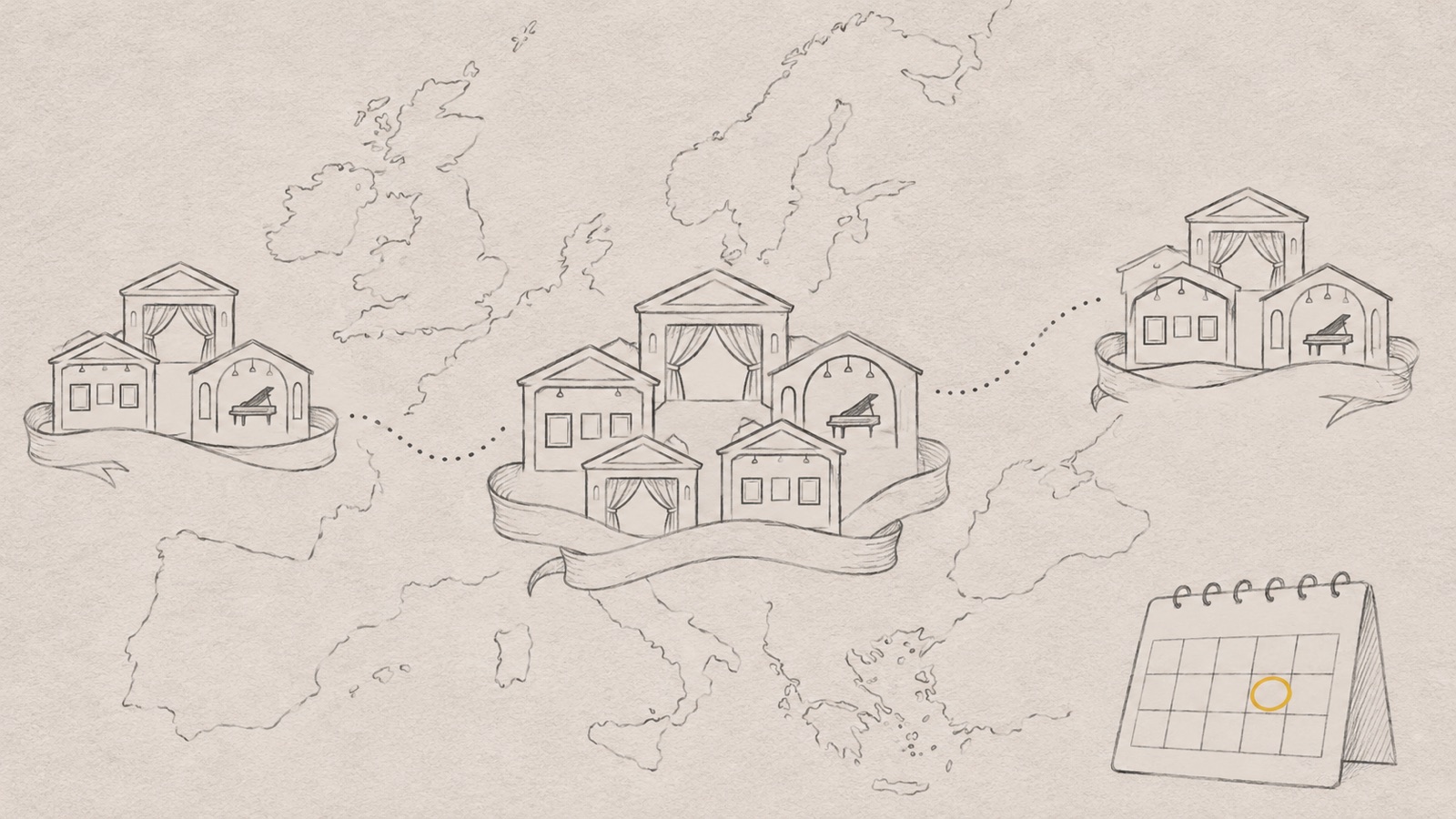
They are transnational projects run by organisations from the cultural and creative sectors in different countries taking part in the programme. The call names them European Cooperation Projects and places them in the Culture strand of Creative Europe, which the Education, Audiovisual and Culture Executive Agency (EACEA) manages. A project can cover one sector or several, and it can be interdisciplinary: a dance company, a design school and a rural festival can apply together.
Every proposal picks one of two objectives set in the call (source):
- Objective 1 - Transnational creation and circulation: co-producing works and touring artists and their work across borders.
- Objective 2 – Innovation: building the skills and capacities of the sector, from new business and audience models to working conditions of artists, inclusion, climate action and digital tools.
The call asks for a clear cross-border cooperation dimension and weighs the history of collaboration between the partners, plus how new organisations join the partnership.
How do small, medium and large scale projects compare?
| Scale | Topic code | Minimum consortium | Maximum EU grant | Maximum funding rate | In the 2026 call? |
|---|---|---|---|---|---|
| Small scale | COOP-1 | 3 entities from 3 countries | €200,000 | 80% | Yes |
| Medium scale | COOP-2 | 5 entities from 5 countries | €1,000,000 | 70% | Yes |
| Large scale | COOP-3 | 10 entities from 10 countries | €2,000,000 | 60% | No |
The small and medium rules come from the 2026 call document, and the large scale rules from the 2025 topic CREA-CULT-2025-COOP-3 (source). The 2026 call ran only two topics: €24,109,270 for small scale and €36,163,904 for medium scale. Large scale projects, with their €2 million cap, did not appear.
The funding rate falls as the project grows. A small project with a €250,000 budget gets at most €200,000, and the partners find the other €50,000. A medium project with a €1.43 million budget reaches the €1 million cap at 70%, so the consortium brings about €430,000 of its own money, ticket income, sponsorship or national co-funding. Write that gap into the plan before you write the story.
How hard is it to win a cooperation project?
The Funding & Tenders Portal publishes the evaluation results of every round. These are the numbers for the last two calls (2026 results, 2025 results):
| Round | Scale | Proposals | Funded | Success rate | Score of the last funded proposal |
|---|---|---|---|---|---|
| 2026 | Small scale | 1,232 | 120 | 9.7% | 89 / 100 |
| 2026 | Medium scale | 598 | 40 | 6.7% | 91 / 100 |
| 2025 | Small scale | 1,029 | 88 | 8.6% | 86 / 100 |
| 2025 | Medium scale | 554 | 24 | 4.3% | 91 / 100 |
| 2025 | Large scale | 80 | 10 | 12.5% | 85 / 100 |
Three things stand out.
- The pass mark is a trap. The call sets an overall threshold of 70 points (source), and in 2026, 801 small scale proposals cleared it. Only those at 89 or above got money. A proposal that scores 85 has passed and still lost.
- Medium scale is the hardest door. In 2026 the 409 medium proposals above the threshold asked for €358.6 million against a topic budget of €36.2 million, nearly ten times the money available.
- Large scale had the best odds. In 2025, 10 of 80 large scale proposals won (12.5%), the highest rate of the three, because few consortia of 10 countries apply. That topic was then left out of the 2026 call.
Who can apply?
The call document sets these eligibility rules (source):
- Legal entities only, public or private, established in an EU Member State (overseas countries and territories included), an EEA country or a country associated to Creative Europe. Natural persons cannot apply, except self-employed sole traders whose business has no separate legal personality.
- The coordinator must have existed as a legal entity for at least 2 years on the deadline date.
- One coordinator role per organisation in the whole call, whichever topic it picks, and each organisation, identified by its PIC number, can take part in at most 3 applications.
- Associated partners take part without funding. The call encourages partners from European Neighbourhood Policy countries in that role, and organisations from the EU’s outermost regions and from rural and peripheral areas.
- Ukraine: the call asks proposals to take the consequences of Russia’s war of aggression into account and supports Ukrainian artists and cultural organisations.
Creative Europe Desks, the national help offices of the programme, can also be coordinators or partners if they keep the project costs separate from their desk grant.
How are proposals scored?
- Relevance, 30 points. Fit with the chosen objective, a sound needs analysis, European added value, new elements built on past results, and the EU priorities. Minimum 15.
- Quality of content and activities, 30 points. Method, a coherent workplan, how the partnership was built and works together, a clear role for each partner, and concrete benefits for the audiences. Minimum 15.
- Project management, 20 points. Coordination and governance, the right teams, a budget built on the real costs of the partners, and checks on risks and on the quality of the work. Minimum 10.
- Dissemination, 20 points. Short, medium and long-term effects, how the results last after the project, communication that reaches the target groups and the public, and visibility of the EU grant. Minimum 10.
Ties are broken by theme first (a theme no higher-ranked project covers wins), then by the Relevance score, then Dissemination. So Relevance decides twice: once in the total and once in a tie.
How does the lump sum work?
Cooperation projects are paid as a CREA Lump Sum Grant. The agency fixes one amount at signature, based on the detailed budget table and the funding rate, and pays it against completed work packages instead of receipts (source). The budget table carries more weight than in a cost-based grant: the call warns that ineligible costs in it can cut the grant. The mechanics are the same as in Horizon Europe, set out in the guide to lump sum funding.
Projects should not normally last longer than 48 months, and the start date follows grant signature. In the 2026 round that meant a call published on 5 March 2026, a deadline on 5 May 2026 at 17:00 Brussels time, results in November 2026 and signature planned for February 2027: roughly a year from submission to the first euro.
What Creative Europe calls are open right now?
The cooperation call closes once a year, while the rest of Creative Europe keeps publishing. This is the programme at this update, read from the portal 3 times a day:
| Strand | Live topics | Combined budget | Next deadline |
|---|---|---|---|
| Culture strand (CREA-CULT) | 1 | €5 million | 27 January 2027 |
| MEDIA strand (CREA-MEDIA) | 11 | €206.77 million | 1 December 2026 |
| Cross-sectoral strand (CREA-CROSS) | 5 | €27.68 million | 20 January 2027 |
At this update no cooperation projects topic is open or announced on the portal. The last two calls closed on 13 May 2025 and 5 May 2026, so a consortium that wants to apply in the next round should have its partners and budget settled by early spring.
Funded cooperation projects also pass money on. These open calls come from projects of the Ukraine cooperation topics, and a single organisation can answer them without building a consortium:
| Open call | Call budget | Deadline |
|---|---|---|
| ZMINA:Resilience. Second call for co-creation funding of international cooperation projects | €187,500 | 4 December 2026 |
| ZMINA:Resilience. Rolling call for International Showcasing of co-creation projects | €950,000 | 15 December 2026 |
| Cultural Horizons: Artistic Mobility | €220,000 | 28 December 2026 |
The full list, with every deadline and budget, is on the page of Creative Europe calls.
How do you prepare a cooperation project application?
- Pick the scale from the partners you trust today. Three solid partners at 80% beat five loose ones at 70%. Every partner counts against its limit of 3 applications, so ask early.
- Choose one objective and write to it. Creation and circulation fits co-productions and touring; the second objective fits projects that change how the sector works.
- Register every partner in the Participant Register for a PIC, and check that the coordinator has 2 years of legal existence on the deadline date.
- Build the detailed budget table on real costs. It fixes the lump sum, so a padded line costs points under project management and can cut the grant.
- Aim for 90, not 70. Score the draft against the four criteria with someone outside the project, and rewrite the weakest section.
- Submit on the Funding & Tenders Portal before 17:00 Brussels time. Every call page on Yellow Grant has a calendar file with the exact deadline.
My prediction: with more than 1,800 proposals across two topics in 2026 and the success rate under 10%, the next call will keep the high pass scores, and partnerships with a track record of working together will take most of the grants.
Keep Creative Europe deadlines on your own site
Cultural networks, Creative Europe partners and university arts offices keep lists of open calls that age within weeks. The free deadlines widget shows live Creative Europe calls on your site, filtered by programme or theme, and updates itself 3 times a day.
Open calls right now
European slate development
ZMINA:Resilience. Second call for co-creation funding of international cooperation projects
ZMINA:Resilience. Rolling call for International Showcasing of co-creation projects
Cultural Horizons: Artistic Mobility
Innovative tools and business models
NEWS - Media Literacy
Films on the Move
Circulation of European literary works
Questions
How much can a Creative Europe cooperation project receive?
In the 2026 call, up to €200,000 for a small scale project at a funding rate of up to 80%, and up to €1 million for a medium scale project at up to 70%. The 2025 call also had a large scale topic: up to €2 million at up to 60%, for consortia of at least 10 entities from 10 countries.
How many partners does a cooperation project need?
At least 3 independent entities from 3 different eligible countries for small scale and at least 5 from 5 countries for medium scale. Affiliated entities and associated partners do not count towards that minimum.
What score do you need to win a Creative Europe cooperation project?
The call sets a pass mark of 70 out of 100, but the budget runs out much earlier. In the 2026 round the last funded small scale proposal scored 89 and the last funded medium scale proposal scored 91.
When is the next Creative Europe cooperation projects deadline?
No 2027 cooperation projects topic is published or announced on the Funding & Tenders Portal at this update. The last two calls closed on 13 May 2025 and 5 May 2026 at 17:00 Brussels time. Yellow Grant lists the new call within a day of its appearance on the portal.
Can an individual artist apply?
No. The applicants must be legal entities. The call document makes one exception for self-employed persons whose business has no legal personality separate from them, such as sole traders.